



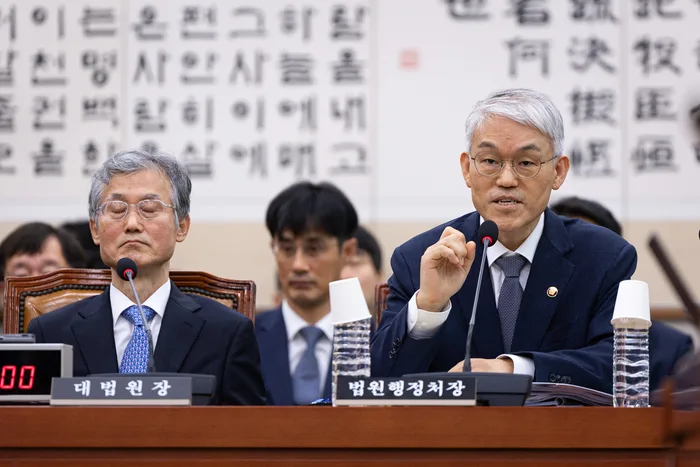
- Chief Justice Cho Hee-dae recommends Daegu District Court Senior Judge Son Bong-ki as Supreme Court Justice without meeting the President
- Ruling party criticizes 'imperial Chief Justice' and reignites judicial reform including amendment to Court Organization Act
- Demoting National Court Administration to Court Administration Office and pushing for judge assemblies to elect court presidents
- Restarting discussions on pending bills such as extending judge suspension period to 2 years and restricting Supreme Court Justice case representations
The Democratic Party of Korea has reignited legislative cards to completely abolish the National Court Administration and drastically reduce the judicial administrative powers of the Chief Justice. As the Chief Justice pushed through the recommendation of a new Supreme Court Justice without a preliminary meeting with the President, the ruling party appears to be launching strong checks under the banner of 'breaking down the imperial Chief Justice system.'
The catalyst was the fact that Chief Justice Cho Hee-dae recently omitted the meeting procedure with President Lee Jae-myung during the process of recommending Daegu District Court Senior Judge Son Bong-ki (61, Judicial Research and Training Institute 22nd term) as the successor to former Supreme Court Justice Noh Tae-ak.
Rep. Kim Seung-won, the ruling party secretary of the Legislation and Judiciary Committee, sharpened his stance on the 21st, saying, "We believe that the system of the imperial Chief Justice has committed such irrationality and illegality." He went on to raise his voice, stating, "We must abolish the National Court Administration, which acts as the riot police for the Chief Justice, and change it into a Court Administration Office so that it can only perform administrative execution."
Currently pending in the Legislation and Judiciary Committee subcommittee is the amendment to the Court Organization Act proposed last December by the Democratic Party's 'Task Force for Overcoming Judicial Distrust and Normalizing Judicial Administration.' This amendment, one of the so-called '3 Judicial Administration Reform Bills,' specifies the abolition of the National Court Administration and requires judge assemblies to directly elect frontline court presidents.
The ruling party is showing momentum to push ahead even further with the remaining judicial reform bills that were previously put on hold. The Democratic Party, which prioritized processing the judicial distortion crime bill, trial appeal system, and Supreme Court Justice expansion bill last March, is expected to bring back to the discussion table the amendment to the Judges Disciplinary Act, which increases the upper limit of the judge suspension period from the current 1 year to 2 years, and the amendment to the Attorney Act, which restricts the handling of Supreme Court cases for 5 years after retirement as a Supreme Court Justice.