


- 2027 Youth Budget Set at KRW 43.3 Trillion… Surges 53.5% Year-on-Year
- Number of Inactive Youth in 20s and 30s Approaches 650,000·Asset Gap Deepens… Shift to Comprehensive Support System
- Large-Scale Cash-Based Welfare Introduced, Including KRW 1 Million for Marriage and Up to KRW 20 Million for Childbirth
- 'Future Response Fund' Relies on Additional Tax Revenue… Limitations in Securing Stable Financial Resources Exposed
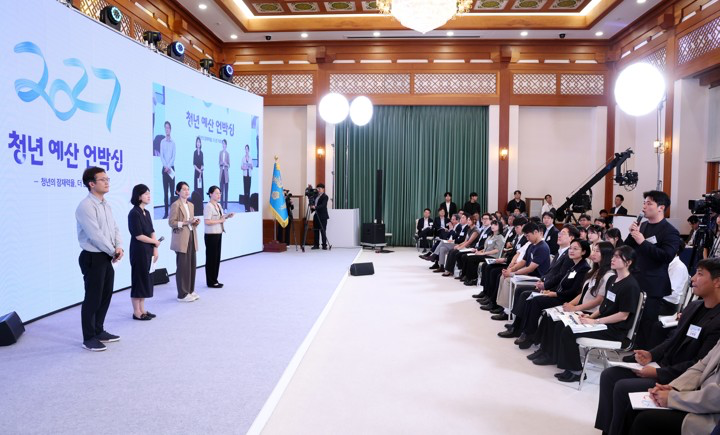
The government has allocated KRW 43.3 trillion for youth policy budgets in 2027. This represents a sharp 53.5% surge compared to KRW 28.2 trillion in 2026. Relevant ministries held the 'Youth Budget Unboxing 2027' event at the Blue House on the 28th and announced a reorganization of existing individual project-centered policies into a comprehensive support system connecting all life stages, including employment, housing, asset building, marriage, and childbirth.
Behind the massive budget injection lies the extremely deteriorated economic reality of the youth generation. As of last month, the population of individuals in their 20s and 30s who are economically inactive and in a state of 'rest' reached 651,000. This is an increase of 240,000 compared to July 2016. The asset gap with the older generation also widened from 2.4 times in 2012 to 3.9 times in 2024. The government judged that fragmentary prescriptions are insufficient to prevent delayed entry into the labor market and asset polarization.
A massive wave of cash-based welfare will be newly established under the name of close support by life cycle. Starting July 2027, the 'Child Welcoming Support Fund' will be introduced, paying KRW 10 million to 20 million to newborn children in four installments depending on the number of children and region. A 'Marriage Support Fund' providing KRW 1 million once upon marriage, along with a universal child allowance paying a maximum of KRW 600,000 per month for ages 0-1 and up to KRW 300,000 per month for ages 2-12, will also be newly prepared. National funds will be poured into overall jobs and housing, such as an annual KRW 7.2 million subsidy for new hires in small and medium-sized enterprises and allocating more than half of universal public rental housing to youth.
The government will shoulder these massive costs by establishing the 'Future Response Fund', financed by additional tax revenues. A national-level 'Mid-to-Long-Term National Development Strategy' will also be unveiled within this year. Although a record-breaking youth budget has been formulated, policies spraying massive amounts of cash amid frequent tax shortfalls carry the risk of leading to the deterioration of national fiscal soundness.