



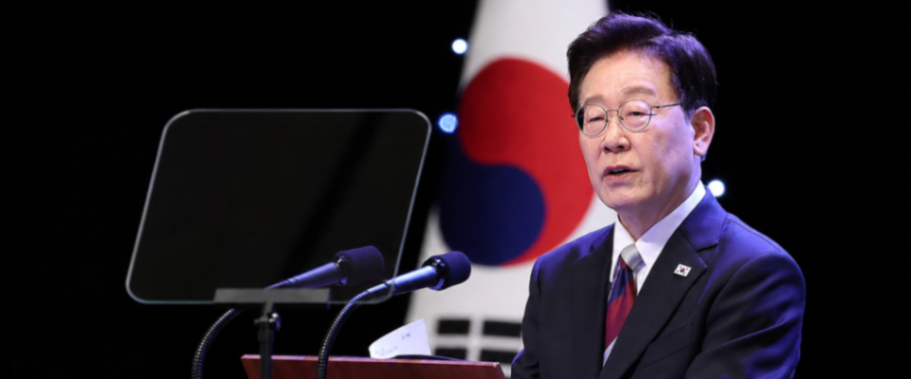
- Officially proposes multilateral end-of-war discussions involving South Korea, North Korea, the US, and China in the 81st Liberation Day congratulatory address
- Lowers the barrier to dialogue by avoiding immediate mention of 'denuclearization' and opting for 'halting the advancement of nuclear capabilities'
- Ministry of Unification focuses on securing momentum for four-party talks and US-North Korea summit using the September UN General Assembly and November APEC as leverage
- Whether North Korea will practically respond remains uncertain amid its declaration of 'two hostile states' and scrapping of the Sept. 19 agreement
President Lee Jae-myung has abruptly proposed a multilateral discussion card for ending the Korean War, involving South Korea, North Korea, the United States, and China, to bring about a complete end to the conflict. His plan is to find a breakthrough in dialogue by adopting a step-by-step approach called 'halting the advancement of North Korea's nuclear capabilities' instead of 'complete denuclearization,' which has been the core of traditional pressure against the North.
On the 15th, President Lee officially proposed multilateral talks to end the war during the 81st Liberation Day ceremony held at the Sejong Center in Seoul, stating, "Let us begin discussions among the parties concerned to end this long-running war." Reaffirming the three principles toward North Korea—respecting its regime, ruling out absorption unification, and halting hostile acts—President Lee presented a blueprint for 'inclusive, stable, and responsible peaceful co-existence.'
What stands out in particular is the shift in approach toward North Korea's nuclear program. Unlike last year's Liberation Day address, which directly mentioned 'denuclearization,' this year he stated, "Effective measures to stop the advancement of the North's nuclear capabilities can also be discussed through multilateral talks." This is interpreted as a realistic judgment to broaden the room for four-party talks involving the two Koreas, the US, and China, prioritizing a 'halt to nuclear weapons' as an initial goal rather than making denuclearization a precondition for dialogue, especially given that North Korea has codified its nuclear force enhancement in its constitution.
Government ministries have also embarked on working-level tasks to realize the four-party talks. The Ministry of Unification plans to use next month's UN General Assembly and November's Asia-Pacific Economic Cooperation (APEC) summit in Shenzhen, China, as diplomatic leverage to secure momentum for four-party talks and a US-North Korea summit. It also plans to simultaneously pursue tension-reduction measures, such as restoring inter-Korean communication channels and publicly discussing the replacement of the term 'main enemy.'
However, it remains unclear whether this four-party talk initiative will actually lead to a negotiating table. Given that North Korea has already defined South Korea as its 'most hostile entity' and the September 19 military agreement has been effectively neutralized, prevailing analysis suggests that the likelihood of North Korea immediately responding to the government's conciliatory proposal to transition to a peace regime is not high.