



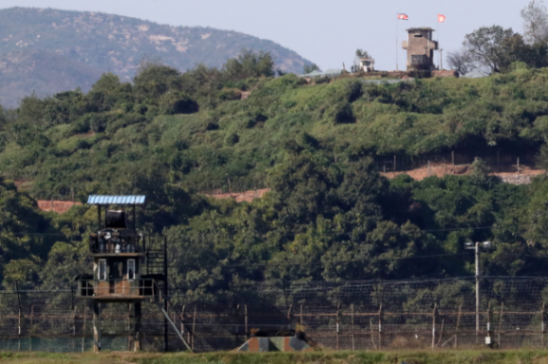
- Korea Institute for National Unification precisely analyzes 160 North Korean military activities from January 2024 to June of this year
- Forward deployment of everything from 155mm howitzers to 600mm super-large multiple rocket launchers… Layered strikes on a nationwide scale
- Frontline conventional firepower linked with the 'nuclear trigger'… Concerns that local conflicts could escalate into nuclear threats
- Risk of 'Korea-passing' due to selective use of UN Command communication channels and prospects of West Sea NLL provocations
Analysis indicates that North Korea is going beyond the fortification of the Military Demarcation Line (MDL) area to build a so-called 'nuclear-armed border,' combining conventional firepower that places the entirety of South Korea within its range with a tactical nuclear operation system. The structural risk is growing that even minor clashes in border areas could immediately expand into tactical nuclear threats.
On the 9th, Hong Min, a senior research fellow at the Korea Institute for National Unification, released the results of an analysis of 160 military activities conducted by North Korea from January 2024 to June of this year through a report titled 'Military Measures for North Korea's Southern Borderization.' According to the report, North Korea's southern borderization has proceeded meticulously in five total stages: border declaration, severance of inter-Korean connection networks, fortification, legislation, and transition of border firepower posture.
The most fatal threat is the multi-layered nature of frontline firepower systems. Moving away from past force deployments centered on long-range artillery targeting the capital area, North Korea has now layered new 155mm self-propelled howitzers (range of 60km or more), upgraded 240mm multiple rocket launchers (90km), tactical cruise missiles (100km), Hwasong-11ra series tactical ballistic missiles (110–136km or more), and 600mm super-large multiple rocket launchers (420km) across its frontline corps. In particular, the deployment of the 420km-range super-large multiple rocket launchers means that firepower deployed at the border alone is capable of striking all of South Korea.
This conventional firepower network is linked with North Korea's national nuclear weapon comprehensive management system, the 'nuclear trigger.' With border security units, frontline artillery, and national nuclear forces bound into a single response structure, a 'trigger-line' structure has been completed where simple border friction can rapidly escalate through conventional precision strikes to the use of tactical and strategic nuclear weapons. General Secretary Kim Jong Un's lowering of the threshold for using armed force—stating that "the violation of even 0.001mm of territorial waters is a war provocation"—also reinforces these concerns.
Diplomatic and security limitations in the response process were also pointed out. North Korea is selectively utilizing only the United Nations Command channel without discarding the Armistice Agreement (such as prior notification of barrier construction work in June and July of last year). This is analyzed as an intention to thoroughly exclude South Korea from discussions on border stability and communicate directly with the United States. Researcher Hong emphasized the high probability that the area beyond land, specifically around the Northern Limit Line (NLL) in the West Sea, will become the next stage for maritime borderization, highlighting the urgency of establishing effective jurisdiction logic and response readiness.