


Behind the world-class achievement of 6.5 million visitors last year lies the limit of a budget frozen at 3.9 billion won for a decade
Painful withdrawal from bidding on two national treasures from the Kansong family, including the Gilt-bronze Triad Buddha with Gymi Inscription, in 2022
Overcrowding far beyond the 4.0 million capacity benchmark set during the Yongsan relocation in 2006 severely degrades exhibition quality
Structural changes urgent, mirroring the limits of Britain's 'Cool Britannia' and the Metropolitan Museum of Art's switch to paid admission in 2018
Having risen to a core platform of K-culture following visits by BTS and BLACKPINK, the National Museum of Korea stands at a crossroads regarding its 18-year-old free permanent exhibition policy. Last year, it attracted 6.5 million visitors, ranking right behind the Louvre Museum in France (approx. 9 million) and the Vatican Museums (approx. 6.83 million). This is a dazzling report card that even surpasses the performance of the British Museum and the Metropolitan Museum of Art.
Lurking behind this record-breaking box office success is the museum's near-collapse financial state. Compared to an annual expenditure budget of 80 billion won, its own revenue is a mere 2.3 billion won. The budget for acquiring artifacts, a core asset, has been capped at 3.9 billion won for 10 consecutive years. Compounded by skyrocketing prices in the ancient art market and consumer inflation exceeding 20%, the museum's actual purchasing power has effectively plunged into negative territory. A prime example was the 2022 incident where, due to financial distress, the museum had to give up even placing a bid on two national treasures put up for auction by the descendants of Kansong Jeon Hyeong-pil, namely the 'Gilt-bronze Triad Buddha with Gymi Inscription' and the 'Gilt-bronze Miniature Shrine of Triad Buddha.'
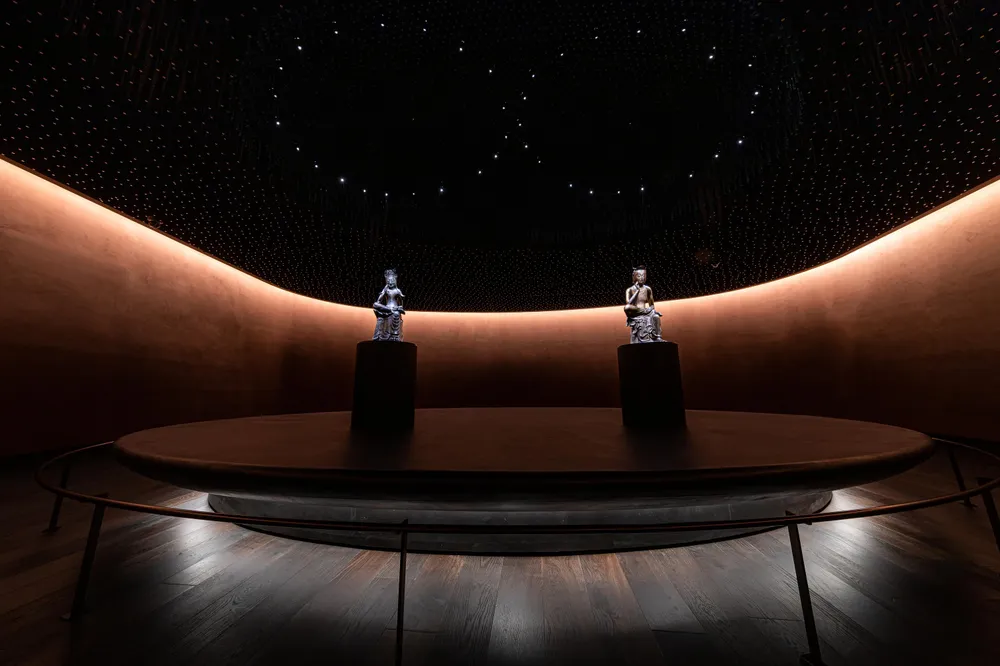
The surge in visitors incurs economic congestion costs, such as long queues for the 'Room of Quiet Contemplation,' degrading the quality of public service. This is the fallout of 6.5 million people flooding a space originally designed in 2006 during the Yongsan relocation to handle an annual capacity of 4.0 million. Momentum is building for the introduction of appropriate exclusion mechanisms to indiscriminately control demand and create a pleasant environment.
Imposing an admission fee of 5,000 won per visitor would secure 32.5 billion won annually. This is a massive sum, amounting to 14 times the current self-generated revenue. Global trends also point toward a transition to paid admission. British public museums, which built the 'Cool Britannia' brand through free admission, are recently suffering from the burden of maintenance costs for soaring tourist numbers. The Metropolitan Museum of Art in the United States broke its long-standing tradition and switched to paid admission in 2018 to secure survival funds.
It is urgent to move away from the vague perception of free admission and secure self-sustainability that treats visitors as legitimate service-using customers. The reservation system scheduled for introduction next year will collect data on visitors' ages, nationalities, and preferences. Building on this, it is time to urgently discuss designing a multi-dimensional pricing policy, such as annual passes, exemptions for low-income groups and students, and discounts for specific days or times.