



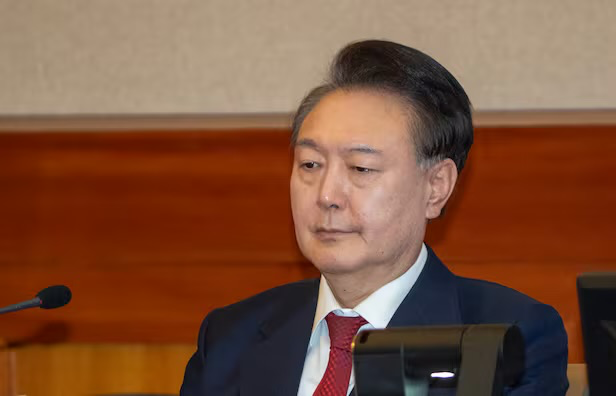
Administrative procedures for revoking lawyer registration completed on the 28th following Ministry of Justice order
Under the Attorney-at-Law Act, persons whose 'imprisonment without prison labor or heavier' is finalized are disqualified for 5 years after sentence completion
7-year prison term finalized by the Supreme Court earlier this month on charges of abuse of authority, including obstructing CIO arrest and ordering deletion of secure phones
Former President Yoon Suk-yeol, whose 7-year prison sentence was recently finalized by the Supreme Court, has permanently lost his lawyer license.
According to the legal community on the 29th, the Korean Bar Association (KBA) received the order to revoke former President Yoon's lawyer registration from the Ministry of Justice on the 24th and completed all related revocation procedures on the 28th.
This is a mandatory measure under the current Attorney-at-Law Act. The Attorney-at-Law Act strictly stipulates that anyone who has been sentenced to imprisonment without prison labor or heavier and for whom 5 years have not passed since the sentence was completed or exempted is disqualified from being a lawyer. The Minister of Justice must order the KBA to revoke the registration if such grounds arise for a person registered in the lawyer roster, and this disqualification was also processed in accordance with this procedure.
Previously, on the 9th, the Supreme Court dismissed the appeal filed by former President Yoon, who was indicted on charges including special obstruction of official duties and abuse of authority, and finalized the lower court ruling (7 years in prison).
Former President Yoon was found guilty on all charges, including obstructing the execution of an arrest warrant by the Corruption Investigation Office for High-ranking Officials (CIO) last January by mobilizing Presidential Security Service personnel, ordering former Security Service Deputy Chief Kim Sung-hoon to delete secure mobile phone communication records, and approving the drafting and disposal of a 'post-hoc martial law declaration' following the lifting of martial law. The appellate court increased his 1st-instance sentence by 2 years to 7 years in prison, and with the Supreme Court finally upholding it, the judicial proceedings have concluded. Null