



Soaring raw material prices, including a 30% jump in marine gas oil, driven by the Middle East war
13 Busan and Gyeongnam construction companies submit a petition to the Ministry of Land, Infrastructure and Transport, warning, "If construction costs are not realistically adjusted, we will withdraw from the consortium"
Limitations of the National Contract Act exposed as a 1-year gap between bidding and contracting fails to reflect inflation fluctuations
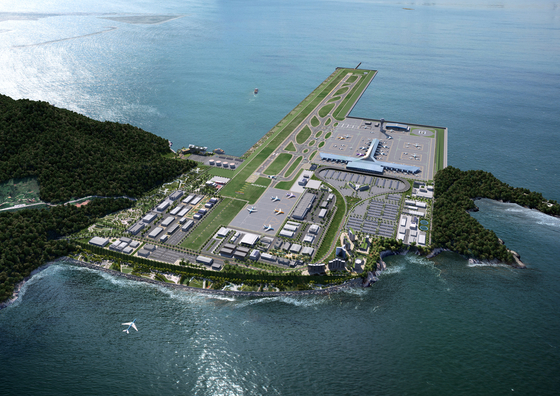
Construction of the Gadeokdo New Airport has hit a snag due to soaring construction costs triggered by the outbreak of the war in the Middle East. Facing the threat of massive cost losses, construction companies in the Busan and Gyeongnam regions are considering withdrawing from the consortium, and backlash is spreading.
According to the Daewoo Engineering & Construction consortium—which is in charge of the Gadeokdo New Airport site development project—and the construction industry on the 28th, 13 regional construction companies in Busan and Gyeongnam recently submitted a joint petition to the Ministry of Land, Infrastructure and Transport (MOLIT) and Busan City demanding realistic adjustments to construction costs. These regional companies, which account for 13% of the total consortium stake, are reportedly considering withdrawing from the consortium if their demands are not met.
The main cause of the soaring construction costs is the Middle East war that broke out in February. Because the project involves extensive offshore construction and large-scale earthwork that require heavy equipment, the price of marine gas oil has surged by a staggering 30% since the war began. According to data compiled by the Korea Institute of Construction Technology, the civil engineering construction cost index also jumped 3.9% from 137.88 in February to 143.30 in May.
As a result, lead contractor Daewoo E&C has also gone into emergency mode. Daewoo E&C estimates that the increase in construction costs alone resulting from the war will reach 400 billion to 500 billion won. Without government action, construction companies face having to shoulder massive losses.
At the root of this situation lies a blind spot in the current National Contract Act. While there is a system for adjusting contract amounts in response to inflation during public construction contracts, it fundamentally applies only "after the contract is concluded." In the case of the Gadeokdo New Airport, an initial bidding notice was issued late last year, a preferred bidder was selected in February this year, and a preliminary contract is scheduled to be signed this November. This has created a structural contradiction where massive inflation fluctuations occurring over a nearly one-year gap cannot be reflected in the construction costs simply because they occur before the preliminary contract is signed.
This is why regional construction companies, which are relatively weak in financial power, have no choice but to bring up the possibility of withdrawal.
MOLIT, the competent ministry, is sharing the situation with the Ministry of Economy and Finance and holding discussions. The construction industry argues that limited special exceptions should be introduced to allow contract amounts to be realistically adjusted when uncontrollable variables such as wars or natural disasters occur.
Experts warn of the repercussions that construction delays would bring. Earlier in 2024, Hyundai E&C, the original consortium lead, dropped out due to construction period issues, delaying the schedule once already. Cho Won-chul, professor emeritus of civil and environmental engineering at Yonsei University, pointed out, "Given the conditions of building close to the sea, this is a project with high risks and burdens," adding, "The later construction starts, the more construction costs will rise, and the burden of operation and maintenance costs is likely to grow as well."