


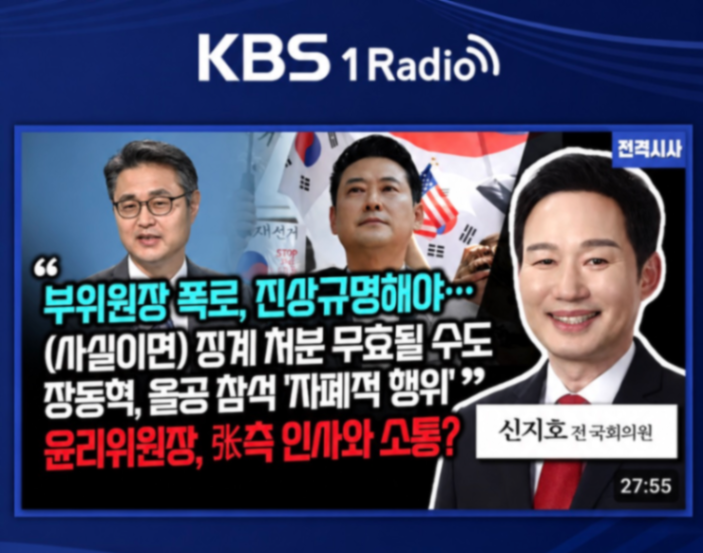
- KBS 1 Radio current affairs program marks Korean family name 'Jang' with simplified Chinese character (张)
- Netizens point out "Traditional characters (張) are default on Korean keyboards... impossible without purposely searching for it"
- Amid growing suspicions regarding nationality of outsourced production staff, KBS maintains silence and issues no official statement
South Korea's public broadcaster KBS has been swept up in intense controversy after using a simplified Chinese character instead of a Korean family name in the thumbnail of its radio YouTube channel. As it was revealed that even basic Chinese character notations were not properly reviewed at a national key broadcaster operated by license fees, viewers' distrust toward the overall internal system is growing beyond a simple mistake.
The controversy began with a video thumbnail uploaded to the KBS 1 Radio 'Jeon-guk Sisa' YouTube channel. In the thumbnail, when referring to a specific individual's side, the simplified Chinese character '张' was inserted instead of the traditional Chinese character '張' (meaning 'to bestow'), which is commonly used in South Korea.
The reason critical public opinion is spreading rapidly across online communities and social media lies in the technical and structural characteristics that make such notation difficult to occur as a mere typo. In general Korean PC and mobile input environments, traditional characters are displayed first when converting Chinese characters. Netizens have expressed strong suspicions, asking, "Isn't an external worker who uses a Chinese language input method in charge of producing the thumbnails?" since it would require purposely going through complex access steps to use simplified Chinese characters.
Viewers are reacting sharply, pointing out the damage to the value of license fees and the decline in content quality of the public broadcaster. However, amidst the growing fallout, KBS has yet to release a specific official statement regarding how this notation came to be, drawing criticism for standing idly by.
This simplified Chinese character incident goes beyond a single character in a thumbnail; it is a clear example that lays bare the absence of new media content production guidelines and the reality of the outsourced workforce verification system at a public broadcaster, and significant repercussions are expected going forward.