



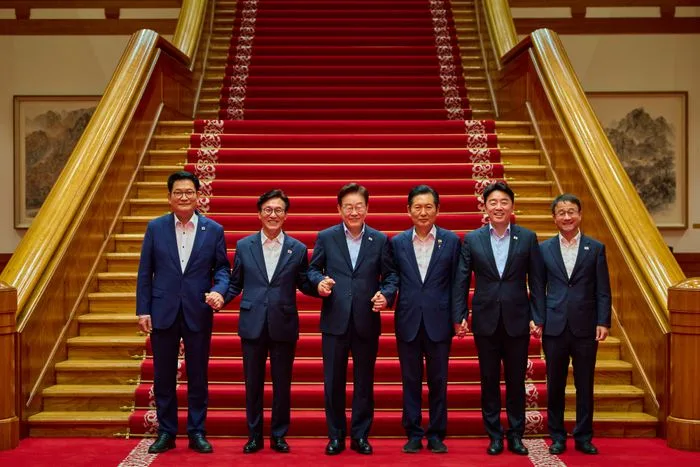
- Declares long-term rule at late Lee Hae-chan's grave on the 20th, targeting "100 years of liberation in 2045 and 100 years of the Democratic Party in 2055"
- Walk the path of legitimacy succeeding DJ, Roh Moo-hyun, and Moon Jae-in… Self-proclaimed successor to the "Lee Hae-chan style strategist and game-maker" lineage
- Orders "Step down, Cho Hee-dae" banners nationwide… Operating a "two-track" strategy of governance vision and pressure on the judiciary
- Concerns over political gridlock amid the absence of a concrete policy roadmap… Leadership of the inaugural Prime Minister-turned-party leader put to the test
Newly appointed Democratic Party leader Kim Min-seok, who served as the inaugural Prime Minister of the Lee Jae-myung administration and now holds the helm of the ruling party, has officially declared a "30-year consecutive rule" extending beyond the next general election to 2055. At the same time, he distributed hardline messages nationwide targeting the head of the judiciary, signaling a severe political storm ahead.
On the 20th, after visiting the grave of former Prime Minister Lee Hae-chan at the Eunhasu Park in Sejong City, Kim told reporters, "We will not merely win general elections, but firmly set the stage for consecutive rule, looking toward a 20- or 30-year golden age of the Democratic Party." By presenting 2045, the 100th anniversary of liberation, and 2055, the 100th anniversary of the founding of the Democratic Party, as target milestones, he made clear his determination to lead the restructuring of the long-term political landscape beyond just managing upcoming elections.
Kim defined himself as a "strategist and game-maker" carrying on the philosophy of former President Kim Dae-jung and following in the footsteps of former Prime Minister Lee Hae-chan. His series of visits following his inauguration—starting with a grave visit on the 17th anniversary of DJ's passing, followed by former President Roh Moo-hyun's grave in Bongha Village, a courtesy call to former President Moon Jae-in in Yangsan, and the grave of former lawmaker Kim Geun-tae in Moran Park—are interpreted as a strategic move to consolidate party legitimacy and establish an inclusive leadership bridging various factions.
Alongside his blueprint for long-term rule, a hardline drive targeting the judiciary also began in earnest. Immediately upon appointing the party's head of public relations, Kim urgently ordered all local party chapters to post two types of banners: "We will open a golden age of democracy" and "Cho Hee-dae, who destroys the rule of law, must step down." This clearly signals a tough stance against the opposition, aiming to present a vision for macro-level state support while directly confronting the judicial risks pressing down on the ruling bloc.
However, criticisms have been raised that compared to the grandiose political slogan of a "30-year golden age," concrete economic and livelihood policies or mid-to-long-term reform roadmaps for pensions, labor, and other issues to support it were not presented. As relations between the ruling and opposition parties and conflicts with the judiciary head toward extremes due to pressure for the Chief Justice to resign, attention focuses on how Kim, elected with 54.08% of the vote, will tackle the realistic tasks of achieving substantive legislative results and political stability beyond grand discourses.