



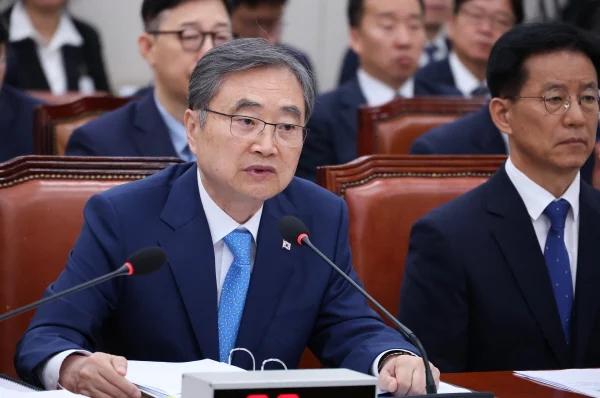
- Foreign Minister Cho Hyun officially acknowledges controversy over being 'passinged' on the reduction of ROK-US joint exercises at the Foreign Affairs and Unification Committee on the 19th
- "Neither government knew before Trump's SNS announcement"... Serious communication gap becomes reality
- Trying to put out the fire by claiming post-hoc consultation "not a unilateral notice", but criticism over 'humiliating diplomacy' ignites
- National security schedule shakes due to unexpected remarks by ally's supreme commander... Diplomatic response capability on the chopping block
Regarding U.S. President Donald Trump's surprise order to scale down ROK-U.S. joint exercises, it has been officially confirmed that South Korea's diplomatic and security control tower received no prior notice whatsoever. Criticism is mounting that a serious hole has been punched in the intelligence-sharing channels of the ROK-U.S. alliance, which has repeatedly been emphasized as ironclad.
Attending the National Assembly's Foreign Affairs and Unification Committee on the 19th, Minister of Foreign Affairs Cho Hyun stated regarding President Trump's remarks on reducing joint exercises, "We were not notified in advance." Minister Cho admitted that there was no prior communication between the diplomatic and defense authorities of the two countries, stating, "The content revealed by President Trump on social media (Truth Social) was something that neither our government nor U.S. government officials knew about beforehand."
Previously, on the 16th (local time), President Trump ordered a drastic reduction in joint exercises citing his relationship with North Korean leader Kim Jong Un, leading to an unprecedented situation where the U.S. Department of Defense immediately began implementation and the drills were cut in half.
In response, Minister Cho attempted to contain the fallout by explaining, "Minister of National Defense Ahn Gyu-back consulted closely with the U.S. side after the social media announcement," adding, "Since our minister consulted together, I do not consider it a unilateral notice."
However, critics point out that this is a clear case of "locking the stable door after the horse has bolted," given that a core issue directly tied to national security was unilaterally and surprisingly announced through the U.S. president's social media, with the South Korean government scrambling to pick up the pieces afterward. Voices are growing louder that the current government's passive diplomatic and security response system—being dragged around by an ally's fickle decisions and effectively receiving notifications after the fact—must be thoroughly overhauled.