



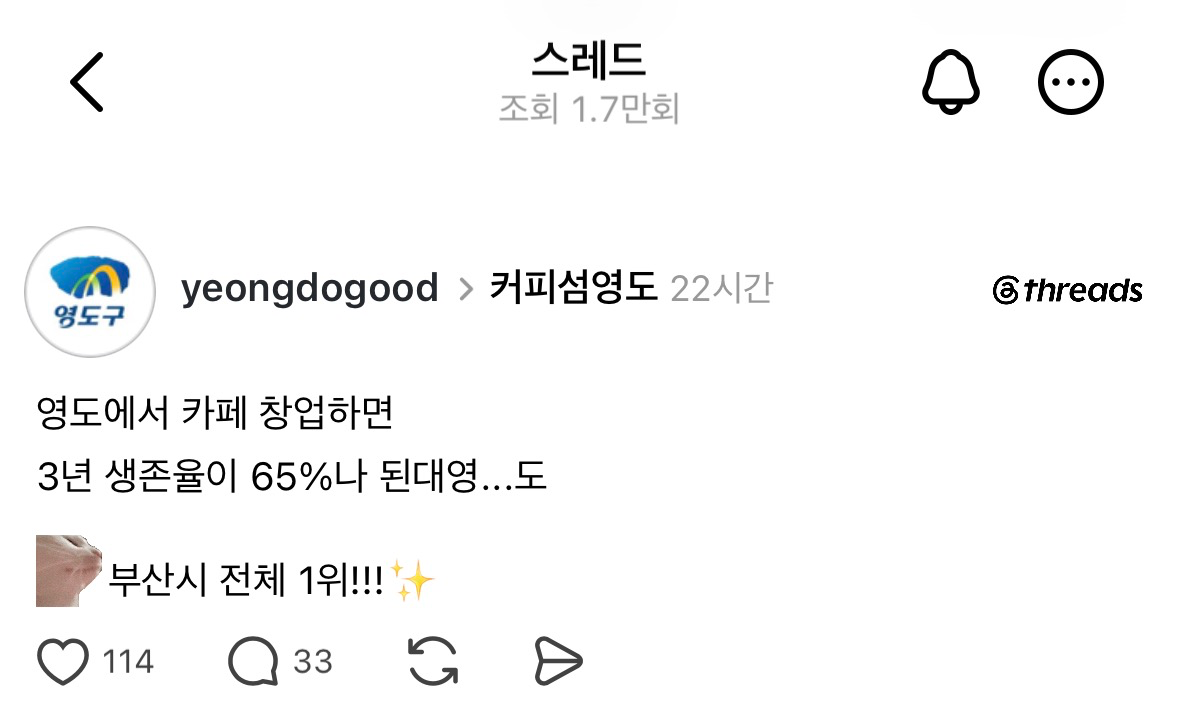
- Yeongdo-gu Office heavily celebrates "65% 3-year survival rate, ranking 1st in Busan," sparking outrage among local merchants
- "We didn't stay open for 7 years because we were making a profit"… Self-employed individuals from other regions also blast "desk administration"
- Busan's median monthly revenue around 4.8 million KRW… An "illusion" as top revenue areas like Haeundae and Gangseo are excluded
- "Except for large businesses, it's a survival of the fittest at a bare subsistence level"… Low rent creates a "stay of execution for closures"
While Busan's Yeongdo-gu launched a major self-congratulatory PR campaign boasting that its local cafes' "3-year survival rate (65%)" ranked first in all of Busan, fierce criticism and cynicism have poured out from local small business owners and netizens, centered around social media. Structural criticisms have been raised that the high survival rate on paper is not actual business success, but rather the result of a "survival of the fittest" where owners cannot even close down due to the burden of sunk costs and demolition expenses.
Recently, a post celebrating the top survival rate was uploaded to Yeongdo-gu's official social media channels. Public sentiment reversed as critical comments analyzing the realities on the ground followed. According to an analysis citing data from the Statistics Korea's Southeast Regional Statistics Office, the average annual revenue of cafes in the Busan region is 150.9 million KRW, but the median revenue—a more realistic indicator—is merely 58 million KRW (about 4.83 million KRW per month). After deducting food and beverage cost ratios, rent, and labor costs, it is virtually impossible to turn a profit.
In particular, despite its high survival rate, Yeongdo-gu failed to enter the top tier of Busan's average regional revenues, which were led by Haeundae-gu (213 million KRW) and Gangseo-gu (202 million KRW). This proves that the survival rate is not driven by the commercial district's profit-generating power.
Reactions from actual netizens and merchants support this. Raw, frontline testimonies flooded the post: "I ran a business in Gimhae for over 7 years, but it wasn't because I was making a profit—I couldn't close even if I wanted to. Would Yeongdo be any different?", "Except for large establishments, most cafes are barely scraping by to cover living expenses," and "People are just hanging on because they can't afford the rent to move elsewhere." The core factor keeping micro-entrepreneurs in Yeongdo-gu is simply the relatively low rent compared to other commercial districts, not survival driven by sales growth.
As of 2024, Busan is already facing an economic downturn where business closures outpace startups. It is a dangerous idea for a local government to package the "delayed closure" phenomenon—where self-employed individuals are forced to keep operating because they cannot afford to forfeit key money and pay tens of millions of won in demolition costs—as an administrative achievement called "No. 1 Survival Rate." It is time for local governments to stop PR campaigns based on empty titles and concentrate their administrative power on resolving the polarization between large and micro-businesses within commercial districts and devising practical exit strategies for struggling small business owners.