



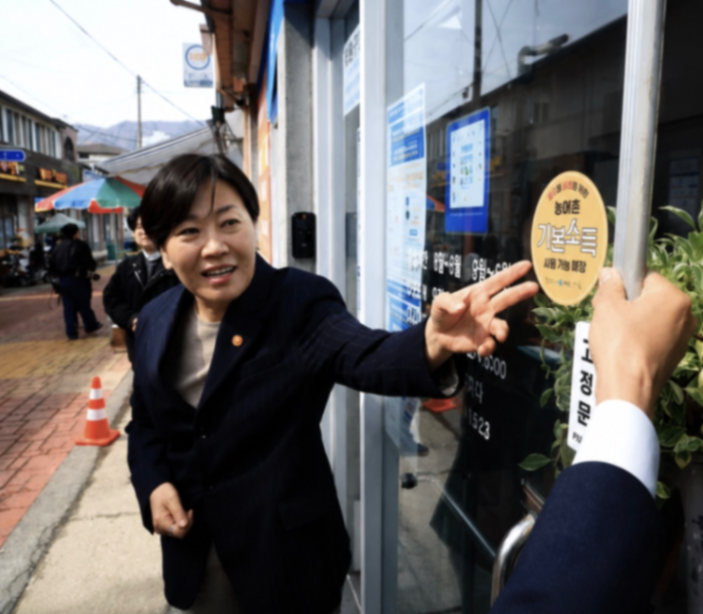
Ministry of Agriculture and Food adds 7 counties including Hwacheon and Boeun… Local love gift certificates to be issued starting August
Revitalization effects seen, such as a 4.7% increase in population in the existing 10 counties… 70.6 billion won in supplementary budget urgently injected
President Lee Jae-myung expresses will to 'make it permanent and raise the amount'… Aiming to pass related bills in the plenary session within the year
Securing stable financial resources remains a task… Urgent need to establish local revenue-generating models such as wind power funds
The 'Basic Income for Rural and Fishing Villages' pilot project, introduced to overcome the crisis of regional extinction, will be significantly expanded from 10 counties to 17 counties. Along with the visible effects of the pilot project and President Lee Jae-myung's expressed will to institutionalize the system permanently, the related legislation is expected to gain momentum.
On the 11th, the Ministry of Agriculture, Food and Rural Affairs (MAFRA) announced that it has additionally selected 7 counties—Hwacheon-gun in Gangwon Province, Boeun-gun in North Chungcheong Province, Jinan-gun and Muju-gun in North Jeolla Province, Gurye-gun and Boseong-gun in South Jeolla Province, and Cheongsong-gun in North Gyeongsang Province—as pilot project sites, with payments beginning in August. This brings the total number of beneficiary pilot project sites to 17 counties.
This project is a system that provides 150,000 won per month in local love gift certificates to all residents living in population-decline areas. The core objective is to revitalize the local economy and prevent population outflow by encouraging consumption within the place of residence. In fact, for the existing 10 counties that began preemptive payments at the end of February, the effects of boosting local vitality were proven with clear figures, such as a 4.7% increase in population and a 13.7% increase in new affiliated stores.
This additional selection was made based on the judgment that the economic downturn following the outbreak of the Middle Eastern war has a greater impact on rural and fishing villages. MAFRA preemptively secured 70.6 billion won through a supplementary budget in April, and finally selected 7 out of 44 applicant regions through a fair evaluation. Residents of the additionally selected regions will receive subsidies starting in August after going through actual residency verification procedures, and the places where the gift certificates can be used will be strictly limited by actual living spheres to prevent a concentration of consumption.
Whether the basic income for rural and fishing villages will be permanently established is also a matter of intense interest. In particular, the day before, President Lee Jae-myung hinted via social media at the necessity of institutionalizing the system permanently and raising the support amount, lending strong momentum to policy implementation. Currently, the bill for the Rural and Fishing Village Basic Income Act has passed the Agriculture, Food, Rural Affairs, Oceans and Fisheries Committee of the National Assembly, and MAFRA aims to pass it in the plenary session within the year. From 2028, when the bill is expected to take effect, a comprehensive readjustment of the budget burden ratio (currently 40% national funds, 30% provincial funds, 30% county funds) along with the permanent introduction of the system is scheduled to be discussed.
However, securing massive financial resources remains the top priority to be solved. MAFRA suggests the establishment of a 'local revenue-generating model' utilizing wind power generation funds or energy profit sharing, and the establishment of stable local government budget-sharing plans between metropolitan and basic local governments as essential alternatives.